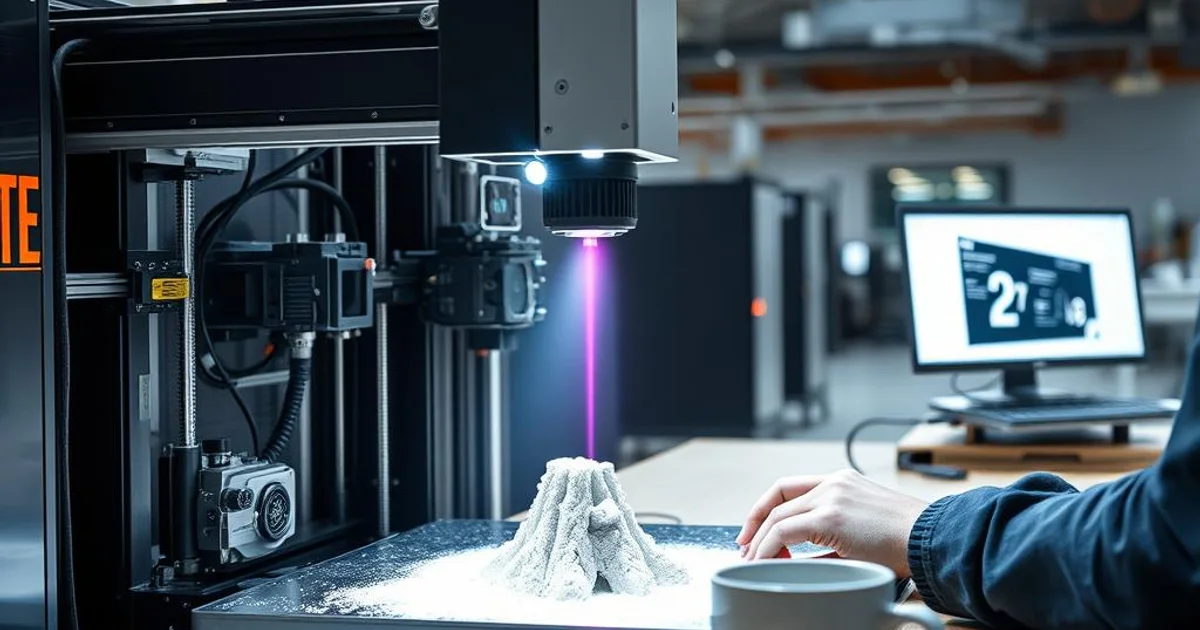
NIST's elliptical laser 3D printing stirs molten metal to create alloys on demand
At a glance:
- NIST demonstrated a metal 3D printing method using elliptical laser beams to stir molten metal during printing, requiring only software updates to existing machines.
- The technique was validated at Argonne National Laboratory's Advanced Photon Source, successfully fusing RHEA-19 high-entropy alloy with titanium alloy in real time.
- Researchers had to write custom control software since commercial 3D printer firmware cannot produce the required elliptical scan patterns.
The breakthrough technique
The National Institute of Standards and Technology (NIST) has developed a novel approach to metal 3D printing that fundamentally changes how alloys are created during the additive manufacturing process. Rather than using traditional laser scanning methods that trace straight lines across metal powder beds, the team programmed lasers to follow looping elliptical paths while melting the powder. This innovative technique creates continuous stirring motion within the molten metal pool, allowing for real-time blending of different metal components as the print progresses.
This method represents a significant departure from conventional laser powder bed fusion techniques, where each brief melt pool typically blends its ingredients only slightly due to the linear scanning pattern. By introducing controlled turbulence through elliptical motion paths, NIST researchers achieved more thorough mixing that results in homogeneous alloy structures with enhanced mechanical properties.
Seeing inside the melt
One of the most challenging aspects of validating this technique was developing methods to observe the alloy formation process as it happened. NIST pioneered an in-situ X-ray diffraction technique at Argonne National Laboratory's Advanced Photon Source, where X-rays pass through the metal and bounce off atomic structures, creating detectable patterns. The Advanced Photon Source generates X-ray beams approximately 500 billion times brighter than a standard dental scanner, providing the intensity needed to capture diffraction patterns from the dense melt pool as it solidified at speeds exceeding one second.
The team combined this real-time X-ray analysis with electron microscopy on finished samples to confirm that the metals had truly alloyed rather than separating into distinct phases. This dual-approach verification represents a breakthrough in materials characterization speed and accuracy, as tracking phase changes during solidification had not been accomplished using this method previously.
Why this matters for manufacturing
Traditional metal casting and 3D printing face significant challenges when creating alloys, particularly high-entropy alloys that contain five or more metals in roughly equal proportions. These materials are prone to separation into weak, blotchy regions as they cool due to differences in density, melting points, and surface tension between component metals. High-entropy alloys are especially susceptible to this problem, making them difficult to cast using conventional methods.
By stirring the molten metal during the printing process, NIST's technique effectively sidesteps these separation issues. The continuous mixing action prevents the formation of heterogeneous regions that would compromise the material's structural integrity. This advancement could enable the reliable production of high-performance alloys that were previously challenging or impossible to create using additive manufacturing.
From lab to factory floor
Perhaps most significantly, the elliptical scanning technique requires no new hardware and can be implemented on existing 3D printers through software updates alone. Commercial 3D printer firmware currently lacks the capability to generate these complex toolpaths, which forced NIST researchers to develop their own control software from scratch. Once refined, this software could potentially be integrated into standard printer operating systems, making the technology accessible to manufacturers worldwide.
The researchers envision that this method could allow machines to feed elemental metal powders and blend them into finished alloys on-the-fly, eliminating the need to stock separate pre-alloyed powders for every desired composition. Additionally, the technique could enable continuous grading of material composition across a single printed part, such as a jet engine turbine blade that might gradually shift between different metals without requiring welded joints that could become failure points.
The research behind it
The findings were published in the journal Additive Manufacturing, Volume 118, on February 25th. This work builds upon NIST's ongoing research into control strategies for suppressing defects and steering microstructure in additive manufacturing. The elliptical scan patterns represent one of several advanced techniques under investigation as part of this broader research initiative.
Metal-based additive manufacturing presents far greater technical challenges than plastic printing, as alloys must withstand extreme temperatures and undergo complex phase changes during cooling. The successful demonstration of real-time alloy formation represents a significant milestone in overcoming these obstacles and advancing the capabilities of industrial 3D printing technology.
FAQ
What makes NIST's elliptical laser technique different from standard 3D printing?
Can existing 3D printers be upgraded to use this technology?
What materials were used to test this technique?
More in the feed
Prepared by the editorial stack from public data and external sources.
Original article